
The need for explainability in AI is widely agreed upon as crucial towards safe and trustworthy deployment of AI systems, especially given the very many opportunities for undesired behaviour, including misinformation, hallucination and bias. In this talk I will advocate the need to think of explainability not as a one-way, one-shot functionality, but rather as a means to empower faithful understandability and follow-up contestability. I will then present approaches based on computational argumentation combined with neural networks to process unstructured data. I will discuss how these neuro-argumentative AI solutions can support contestability by allowing AIs to (1) interact to progressively explain outputs and/or reasoning as well as assess grounds for contestation provided by humans and/or other machines, and (2) revise decision-making processes to redress any issues successfully raised during contestation. I will ground the talk in LLM-based claim verification.
Francesca Toni is Professor in Computational Logic at the Department of Computing, Imperial College London, UK. She is also the founder and leader of the CLArg (Computational Logic and Argumentation) research group and of the XAI research Centre at Imperial. Her research interests lie within the broad area of Knowledge Representation and Reasoning in AI and Explainable AI, and in particular include Argumentation, Argument Mining, Logic-Based Multi-Agent Systems, Non-monotonic/Default/Defeasible Reasoning, Machine Learning. She graduated, summa cum laude, in Computing at the University of Pisa, Italy and received her PhD in Computing from Imperial College London. She has coordinated two EU projects, received funding from EPSRC and the EU, was awarded a Senior Research Fellowship from The Royal Academy of Engineering and the Leverhulme Trust, was Technical Director of the ROAD2H EPSRC-funded project and co-Director for the Centres of Doctoral Training in Safe and Trusted AI and in AI for Healthcare and Royal Academy of Engineering/JP Morgan Research Chair on Argumentation-based Interactive Explainable AI (2020-25). She has been awarded in 2021 an ongoing ERC Advanced grant on “Argumentation-based Deep Interactive Explanations” and is currently the principal investigator of the UK-Japan BeSyDebates project funded by EPSRC in the UK. She is EurAI fellow, AAAI fellow, AAIS fellow and a fellow of the BCS. She has published over 200 papers, co-chaired ICLP2015 (the 31st International Conference on Logic Programming), KR 2018 (the 16th Conference on Principles of Knowledge Representation and Reasoning), and COMMA 2022 (9th International Conference on Computational Models of Argument), was the conference chair for ICLP 2023 and for IJCAI-ECAI 2026. She is corner editor on Argumentation for the Journal of Logic and Computation, in the editorial board of the Argument and Computation journal and associate editor for Theory and Practice of Logic Programming. She is also in the Board of Directors for KR Inc. and IJCAI trustee.

Over the past two decades, AI has moved from explicit representations of meaning and knowledge to increasingly powerful Large Language Models (LLMs) capable of remarkable generalization. Yet many of the challenges that motivated computational semantics in the first place, i.e. multilinguality, grounding, interpretability, reliability, and controlled access to structured knowledge, remain highly relevant in the LLM era. In this talk, I will revisit this evolution through the lens of BabelNet, the Italian LLM Minerva, and its AI assistant ChatMinerva, highlighting what we have learned from building large-scale semantic resources and generative AI systems. I will argue that the future is not simply about replacing symbolic semantics with LLMs, but about bringing meaning, knowledge, and reasoning back into the design of next-generation AI.
Roberto Navigli is Professor of Natural Language Processing at Sapienza University of Rome, where he leads the Sapienza NLP Group. He is a Fellow of ACL, AAAI, ELLIS, and EurAI. He has received two ERC grants on multilingual lexical and sentence-level semantics, highlighted among the 15 projects through which the ERC has transformed science, as well as several prizes and awards from leading AI and NLP journals and conferences. He is the creator of BabelNet and leads the Minerva LLM and ChatMinerva projects - the first family of LLMs and AI assistants pretrained with a focus on Italian, and among the very few initiatives of this kind in Europe. He is also Scientific Director and co-founder of Babelscape, a successful deep-tech company with ten years of experience in research-driven multilingual neuro-symbolic NLP. He is an Action Editor of TACL, served as General Chair of ACL 2025, and has served as an Associate Editor of the AI Journal.
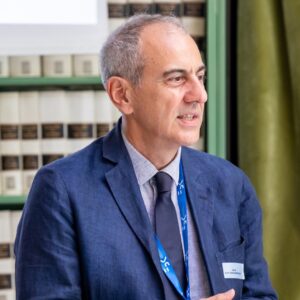
Director, Human Inspired Technology Research Center (hit.psy.unipd.it)
Director, Augmented Intelligence Center (augmentedintelligence.fbk.eu)
In this talk, I present a broad research program centered on advancing graph neural networks (GNNs) across multiple frontiers. I begin with alternative optimization strategies, introducing backpropagation-free, boosting-based local learning as an efficient and biologically plausible training paradigm. I then turn to explainability, presenting a method for the exact computation of any-order Shapley interactions grounded in cooperative game theory, which produces interpretable interaction graphs (SI-Graphs). Next, I discuss graph dynamical systems, where interpretable neural networks (GKAN-ODE) recover symbolic governing equations directly from observed trajectories. I introduce FLAGG, a flexible autoregressive framework for controllable graph generation, and D4, a distance-diffusion approach enabling fully equivariant molecular design. I close by discussing an issue concerning the use of Dirichlet energies as a diagnostic tool for over-smoothing in GNNs. Together, these results offer a cohesive perspective on optimization, interpretability, dynamics, generation, and geometry in modern graph learning.
Alessandro Sperduti is a full professor at the "Tullio Levi-Civita" Department of Mathematics at the University of Padua. He also serves as director of the Center for Augmented Intelligence, Fondazione Bruno Kessler, as well as of the Human Inspired Technology Research Interdepartmental Center at the University of Padova. His research interests lie in Machine Learning, and mainly Neural Networks (Deep Learning), Kernel Methods, and Process Mining. Prof. Sperduti has been a member of many program committees of international conferences (such as NeurIPS, ICLR, ICML, IJCAI, ECAI, ECML, SIGIR,...), program chair of a number of IEEE symposia in Deep Learning, general chair of ICPM 2020 and IEEE WCCI 2022, and guest editor of special issues of international scientific journals. He serves or has served on the editorial board of international scientific journals, such as the IEEE Transactions on Neural Networks and Learning Systems, Neural Networks Journal, the European Journal on Artificial Intelligence, IEEE Intelligent Systems Magazine. He has been a member of the European Neural Networks Society Executive Committee. He is an IEEE senior member and has served as chair of the IEEE CIS DMTC and the IEEE CIS NNTC. He received the "Marco Somalvico" award from the Italian Artificial Intelligence Association AI*IA in 2000 and was designated 2022 Italian Knowledge Leader by ENIT. He has been an invited speaker at the international conferences ICANN 2001, WSOM 2007, CIDM 2013, WSOM 2019, and ICANN 2021. Prof. Sperduti is the author of more than 300 scientific publications.